





Uniqode is best known as a QR code platform, and its digital business cards come from the same mindset: branded cards shared by QR code, wallet pass or email signature, locked templates, directory automation and detailed engagement tracking. For large organisations that already run QR campaigns on Uniqode, adding cards to the same contract can make sense. For a team that mainly wants business cards, lead capture and CRM sync, it is often more than they need, and there is no published price to check before talking to sales.
This guide compares six Uniqode alternatives for teams on what decides the real cost and effort: published team pricing, whether a physical NFC card is included, which plan includes your CRM, identity features such as SSO and directory sync, and how event lead capture is charged. Every price comes from the vendor's own pricing page and is shown as of November 2026. We make Tapni, a digital business card and lead capture platform for teams that is part of Tapstack, so we have been careful to describe every other vendor fairly. Plans change often, so check current terms before you sign.
The short version
- Tapni: one published price per user per year with a standard NFC card for every user, lead capture and native CRM integrations in the same plan, and volume tiers that lower the price as the team grows.
- Blinq: a polished team card and email signature product with CRM sync on Business, and event lead capture as an optional add-on.
- HiHello: brand and signature templates, Google and Microsoft SSO with directory sync on its Business plan, and a pooled monthly scan allowance.
- Wave Connect: a low per-user price for small teams, with event badge scanning paid per lead in credits.
- Dot: team plans that include a device for every member, with CRM integrations on the higher tier.
- Popl: an event lead capture platform first, with digital business cards for the team and pricing by quote.
Why teams look for Uniqode alternatives
Uniqode's card product is capable. Its digital business card page lists customizable templates with locked fields for team-wide consistency, sharing through the Uniqode Cards app, Apple and Google Wallet, Apple Watch, email signatures, text messages and virtual backgrounds, badge and paper card scanning, a built-in CRM or integrations with HubSpot, Salesforce and more, and automation with Okta, Entra ID, bulk uploads and APIs. It also offers multi-org management, GPS-based tracking and connections to Google Analytics, Meta Pixel and Google Ads.
When teams compare alternatives, it is usually for one of these reasons:
- Cards are only in the custom plan. As of November 2026, Uniqode's pricing page lists three self-serve plans, Essential at $9, Core at $49 and Plus at $99 per month billed yearly, and marks digital business cards as "available only on Business+". Business+ is a custom plan you build with Uniqode's sales team, so there is no published per-user price for cards.
- It is a QR platform first. Business+ is assembled from modules such as QR codes, Linkpages and forms, digital business cards, event lead capture, GS1 Digital Links, AI agents and audience insights. That breadth is useful for marketing teams, but a sales team that only needs cards pays for a platform built around QR campaigns.
- No physical card in the offer. Uniqode's card page describes sharing by app QR code, wallet, signature, text and virtual background. It doesn't list physical NFC cards, so if your team wants tap-to-share cards, you source them elsewhere.
- Event lead capture is a separate module. Contact capture with AI enrichment is listed as its own Business+ building block, so check whether your quote includes it.
None of these is a flaw. They follow from a product built for organisations that want QR codes and cards from one vendor. For a feature-by-feature view, see our Tapni vs Uniqode comparison.
When Uniqode is still the right choice
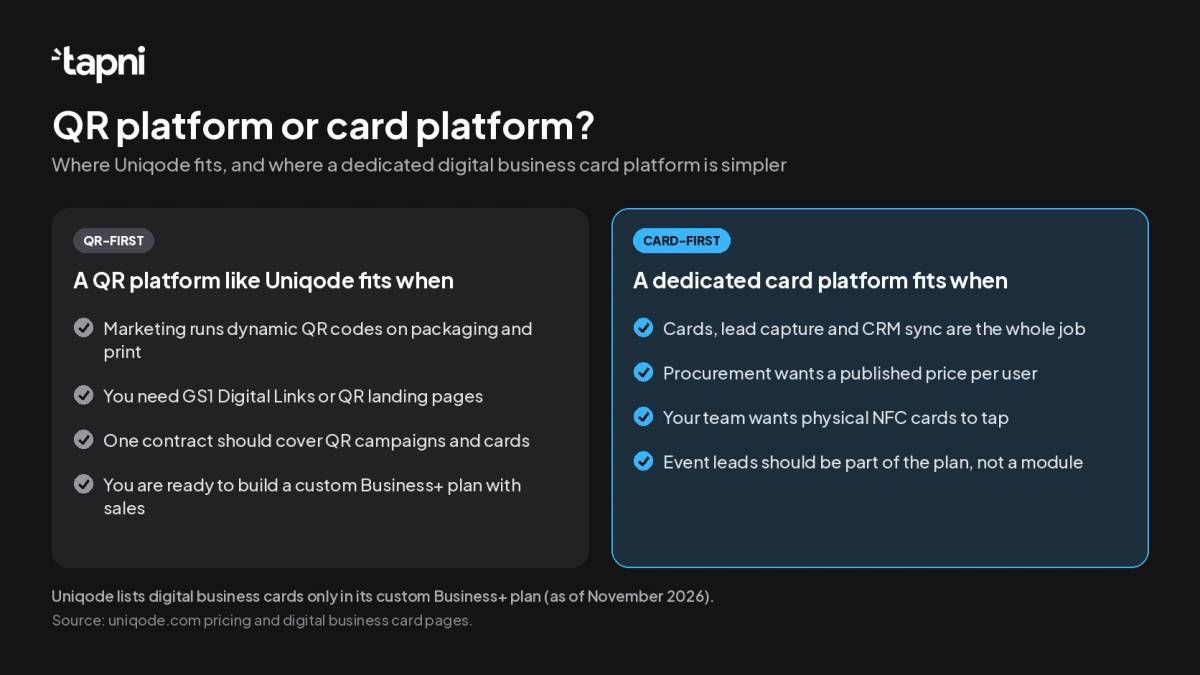
Stay with Uniqode, or shortlist it, if your marketing team runs dynamic QR codes at scale on packaging, print and retail displays, you need GS1 Digital Links, or you want one contract and one admin console for QR campaigns and employee cards across several brands. In that case the custom plan reflects what you actually use. If cards, lead capture and CRM sync are the whole job, a dedicated card platform with a published price is usually simpler to buy and roll out.
Uniqode alternatives at a glance
Published list prices for each vendor's main team plan, as of November 2026, with Uniqode as the baseline in the first row. "Annual" means billed annually.
| Platform | Team plan list price | NFC card in the plan | CRM and SSO | Event lead capture |
|---|---|---|---|---|
| Uniqode | Custom Business+ plan through sales | Not listed | HubSpot, Salesforce and more; SSO in every Business+ plan | Separate Business+ module |
| Tapni | $59.90 per user per year for 1–10 users, $39.90 at 21–30 users | Yes, a standard NFC card per user | HubSpot, Salesforce, Pipedrive, Dynamics, Zoho, Odoo, Attio; SSO and SCIM on Enterprise | Included: profile forms and AI scanner for paper cards and badges |
| Blinq | $4.99 per card per month, annual; minimum 5 cards | No, sold separately | Salesforce, HubSpot, Dynamics 365 and more; SSO and SCIM on Enterprise | Add-on: $500 per event or $4,999 unlimited |
| HiHello | $5 per user per month, annual; 5–100 users | Not listed in the plan | Salesforce, HubSpot, Microsoft Dynamics; Google and Microsoft SSO | 50 card or badge scans per user per month, pooled |
| Wave Connect | $5 per user per month, annual; minimum 3 users | No, optional and sold separately | Native CRM sync; SAML SSO and SCIM on Enterprise | Credits: $2.50 each, 4 per badge |
| Dot | $8 per member per month, annual | Yes, a standard device per member | CRM on Growth ($15 for 1–15 members, custom from 16); SSO not listed | AI paper card scanner on Growth |
| Popl | Pricing on request | Ask sales | Self-serve CRM and calendar integrations; ask about SSO | Core product: badge scanner and enrichment |
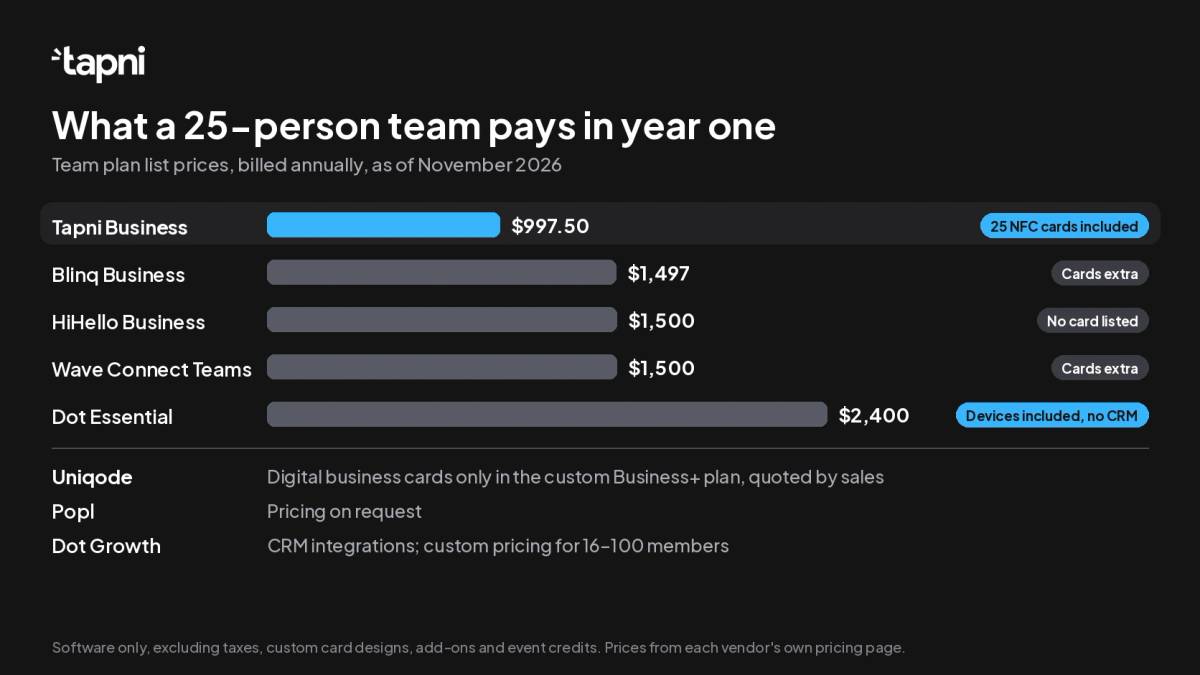
The chart uses a 25-person team because that is a common size for a first company-wide rollout. At that size, Tapni's per-user price is already on its third tier, while the other published prices stay flat until a higher band.
The 6 best Uniqode alternatives for teams
1. Tapni
Best for: teams that want cards, profiles, lead capture and CRM sync in one published price per person, without a custom quote for a standard rollout.
Tapni Business is priced per user per year, and the price drops as the team grows: $59.90 per user per year for 1–10 users, $49.90 for 11–20 users, $39.90 for 21–30 users and $29.90 for 31–49 users. Teams of 50 or more get custom pricing. Every user gets a free standard NFC card and Tapni PRO, so a 25-person team pays $997.50 a year with 25 cards included.
What teams get:
- NFC cards and branded profiles. Cards in PVC, bamboo or metal can be printed with your design and each person's name, and profiles can live on your own domain, such as yourcompany.link/julia. Our help guide explains how to connect a custom domain. We print and ship the cards, and onboarding support is free.
- Brand control. Logos, colours and layouts live in templates, and admins decide which fields people can edit.
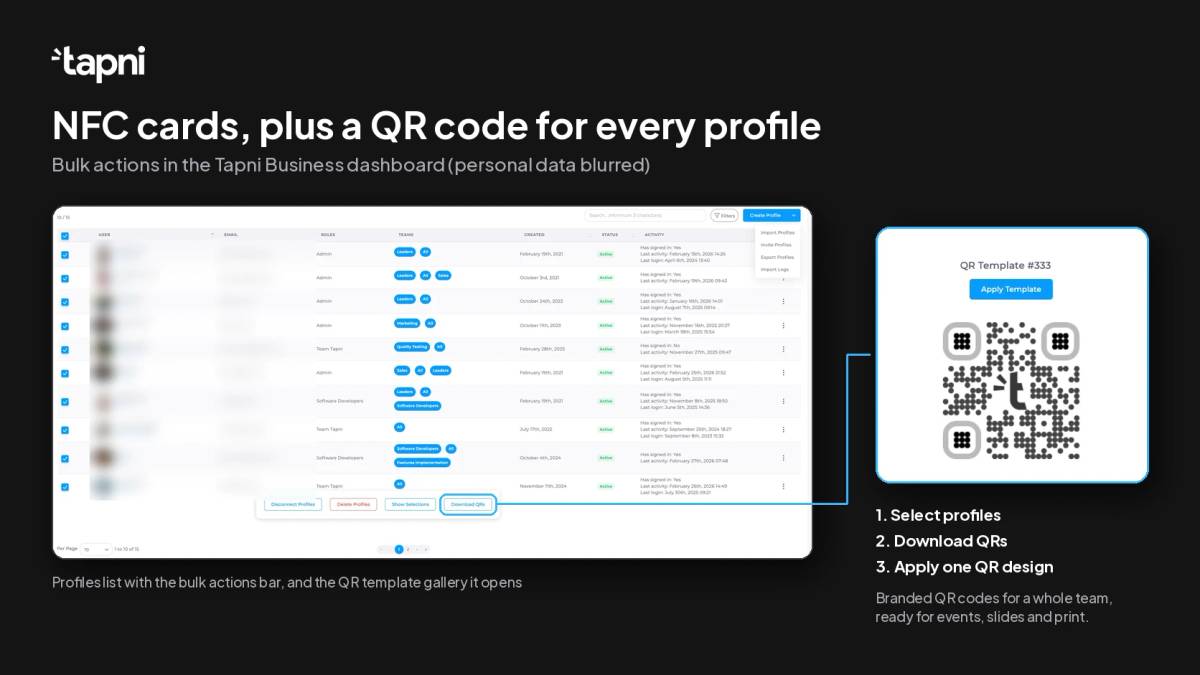
- QR codes as well as NFC. Every profile has a QR code for phones without NFC, and admins can download QR codes for a whole selection of profiles at once with a shared QR design. For one-off codes, our free QR code generator creates vCard and URL codes.
- Lead capture in the plan. Two-way contact exchange from every profile, an AI scanner in the Tapni app that captures details from paper cards and event badges, and notes, tags and follow-up reminders.
- CRM sync. Native integrations with HubSpot, Salesforce, Pipedrive, Microsoft Dynamics, Zoho, Odoo and Attio, plus Zapier, SFTP export and a public API. Our guide to digital business card CRM integration shows how the sync works.
- Team dashboard. Import people from a CSV file, Microsoft Entra ID or Google Workspace, update profiles centrally and deactivate a card in one click when someone leaves.
- Analytics. See your most active employees and each person's profile views by NFC tap, QR scan and link, with date filters and CSV/XLSX/PDF export.
- Wallet passes, email signatures and virtual backgrounds from the same profile data. Your data is hosted on AWS in the Frankfurt region.
Worth knowing: SSO and SCIM provisioning, advanced CRM mapping, role-based permissions and the Azure Entra integration are listed under Tapni Enterprise, which our sales team quotes. Tapni focuses on employee cards and lead capture rather than marketing QR campaigns on packaging and print, so if those are a core need, keep a QR platform alongside it. The included card is the standard NFC card, so ask about custom-designed, bamboo or metal cards when you request a quote.
2. Blinq
Best for: teams that want a polished card and email signature product with a low published seat price.
Blinq Business costs $4.99 per card per month billed annually, with a minimum of five cards and a 30-day free trial. It includes digital business cards for the whole team, admin-controlled email signatures, custom card templates with brand control, automated card provisioning, a corporate contact book, native CRM integrations with Salesforce, HubSpot, Dynamics 365 and more, and individual and team analytics. Admins and team members without a card assigned aren't billed.
Worth knowing: Event Lead Capture is an optional add-on at $500 per event or $4,999 for unlimited events. NFC cards are sold separately in Blinq's shop, and enforced SSO, SCIM provisioning and subteam admin access are part of Blinq Enterprise. Our Blinq alternatives guide looks at it in more depth.
3. HiHello
Best for: brand and IT teams that want templates, signatures and Google or Microsoft SSO without an enterprise contract.
HiHello Business costs $5 per user per month billed yearly ($60 per user per year) for teams of 5 to 100 users, with a five-user minimum and a 14-day free trial. The per-user price drops at 26 and again at 51 users. The plan includes 10 card templates and 10 signature templates, four cards per user pooled across the team, email signatures deployed to Gmail and Outlook, a lead capture form and event lead capture, and integrations with Salesforce, HubSpot and Microsoft Dynamics. It also includes 50 paper card or badge scans per user per month, pooled across the team, plus Google and Microsoft SSO with directory sync.
Worth knowing: the Business plan doesn't list a physical NFC card. SAML SSO and SCIM for providers such as Okta, your own branded subdomain and unlimited scans are part of HiHello Enterprise for 100 or more users, which is the closest match to what Uniqode's Business+ bundles.
4. Wave Connect
Best for: small teams that want a low per-user price and run only a few events a year.
Wave Connect Teams costs $5 per user per month billed annually, with a minimum of three users and a 14-day trial. It adds an admin platform, bulk profile editing, custom templates with locked content, admin email signatures, a shared contacts dashboard and advanced team analytics on top of native CRM sync from the Pro plan.
Worth knowing: event lead capture is priced in credits at $2.50 each, with four credits per event badge and one per lead form, paper card or LinkedIn scan; Wave doesn't charge when it can't find the person's details. NFC cards are optional and sold separately, and SAML SSO, SCIM and custom domains are part of the quoted Enterprise plan. Our Wave Connect alternatives guide covers the credit model in detail.
5. Dot
Best for: teams that want a device for every member bundled into a per-member price.
Dot's team plans are priced per member per month, billed annually. Essential costs $8 per member per month and includes a complimentary standard device for every member, profile templates, profile content restrictions and team management. For teams of 1–15 members, Growth costs $15 per member per month and adds complimentary custom devices, the advanced dot.Profile+, an AI paper business card scanner, member contact management, white-label profiles, team networking insights and CRM integrations. For 16–100 members, Growth is priced through sales.
Worth knowing: CRM integrations are on Growth, not Essential, so a team that needs CRM sync pays the higher tier or gets a quote. Dot's teams page doesn't list SSO or directory sync.
6. Popl
Best for: event-heavy teams whose main goal is badge scanning and lead enrichment.
Popl's team pricing is on request. Its pricing page says plans include unlimited events and conferences, an AI badge scanner, contact and company data enrichment, event campaigns and qualifying questions, self-serve CRM and calendar integrations, dedicated CSM onboarding and digital business cards for your team.
Worth knowing: Popl positions itself as an event lead capture platform, so if most of your team needs everyday cards rather than trade show scanning, compare what you would pay per person against a card-first plan. Like Uniqode, there is no published price, so budget time for a sales process.
How to choose the right Uniqode alternative
Start with what your team does every week, not the longest feature list. These questions usually decide it:
- Do you need QR campaigns as well as cards? If marketing runs dynamic QR codes on products and print, a QR platform may still belong in your stack. If not, don't pay for one to get cards.
- Do you need a published price? If procurement wants a number before a call, Tapni, Blinq, HiHello, Wave Connect and Dot publish team prices; Uniqode and Popl quote.
- Does everyone need a physical card? Tapni includes a standard NFC card for every user and Dot includes a device per member. Blinq and Wave Connect sell cards separately, and HiHello and Uniqode don't list one in the plan.
- What does IT require? If SSO, SCIM or directory sync is mandatory, find out which tier includes it and what that tier costs for your headcount.
- How many leads do you capture at events? Compare lead capture included in the plan with per-event add-ons and per-badge credits at your real volume.
- What happens when someone leaves? Check how cards are deactivated or reassigned, and where that person's leads end up.
Then run a short pilot with a handful of people. Our checklist of 15 questions to ask a digital business card provider turns this into a scorecard you can use with every vendor.
How to switch from Uniqode without breaking your QR codes
The step people miss when leaving a QR-first platform is the codes already in circulation. Card QR codes live in email signatures, wallet passes, slides and printed material, and they point to the old platform's links. Plan the switch so nobody shares a dead link.
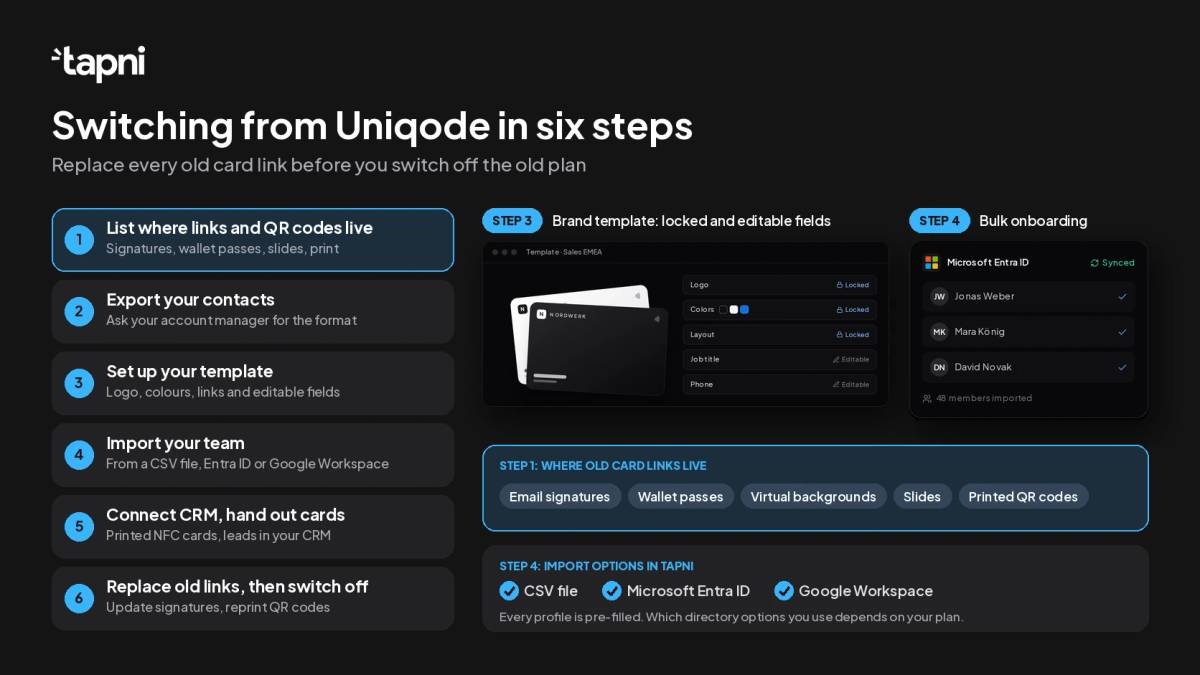
- List where your card links and QR codes are used. Email signatures, wallet passes, virtual backgrounds, event materials and anything printed. Keep the old plan active until each of them is replaced.
- Export your contacts. Ask your Uniqode account manager how to export contacts and card data, and export before your contract ends.
- Set up your template. Recreate your brand on the new platform: logo, colours, company links and which fields people can edit.
- Import your team. In Tapni, you can add people from a CSV file, Microsoft Entra ID or Google Workspace, and every profile is pre-filled. Which directory options you use depends on your plan.
- Connect your CRM and hand out the cards. Connect your CRM so new leads flow in from day one. With Tapni, we print and ship the NFC cards ready to tap.
- Replace the old links, then switch off. Update signatures and wallet passes, reprint QR codes on new material, and cancel the old plan once nothing points to it.
For the people side of a rollout, from pilot group to adoption, read our guide to rolling out digital business cards for teams.
FAQ
How much do Uniqode digital business cards cost?
As of November 2026, Uniqode's pricing page lists digital business cards only in its custom Business+ plan, which you build with the sales team, so there is no published per-user price. The self-serve Essential, Core and Plus plans, at $9, $49 and $99 per month billed yearly, don't include digital business cards.
What is the best Uniqode alternative for teams?
It depends on what you need most. If you want NFC cards, lead capture and native CRM sync in one published per-user price, look at Tapni. If templates and Google or Microsoft SSO on a mid-tier plan matter most, look at HiHello. If event badge scanning is the main goal, Popl focuses on that. Shortlist two or three and run a pilot.
Which Uniqode alternatives include an NFC card?
Among the plans in this guide, Tapni Business includes a standard NFC card for every user, and Dot's team plans include a device for every member. Blinq and Wave Connect sell NFC cards separately, and HiHello's Business plan doesn't list one.
Will our existing QR codes keep working if we leave Uniqode?
Plan on replacing them. Card QR codes point to links on the platform that created them, so update email signatures and wallet passes when the new cards go live, reprint QR codes on new material, and keep the old plan active until nothing in circulation points to it.
Find the right fit for your team
The best Uniqode alternative is the one whose plan already covers what your team uses every day: the cards, the CRM, the identity features and the lead capture, at a price you can see before the first sales call. If you want to see how Tapni handles cards, profiles, leads and CRM sync for a team like yours, visit Tapni for Business or book a 30-minute demo with our team.


